

Synthesis Report: Generation Equality’s Multi-Stakeholder Partnership Approach
Executive Summary
This Synthesis Report documents that over its first five years, Generation Equality has shown how collaboration across sectors and regions can help drive change. By promoting shared leadership, accountability, and inclusive participation, the initiative created new ways for diverse actors to work together, respond to threats against women’s rights, and influence global policy discussions. Its work contributed to stronger attention to gender equality in digital policy, greater recognition of the care economy, improved accessibility standards in international spaces, and coordinated responses to attacks on women’s rights in different countries. At the same time, the report stresses that important challenges remain. Participation and resources are still unevenly distributed, and sustaining inclusive collaboration requires significant time, funding, and coordination. Even so, the experience of Generation Equality shows that meaningful progress depends not only on commitments and results, but also on how people and institutions work together. Trust-building, shared decision-making, and collective action are essential for sustaining momentum for gender equality in an increasingly fragmented and uncertain global context.
A new way of working for gender equality
Generation Equality has demonstrated a fundamentally different approach to advancing gender equality, one rooted in collaboration across governments, civil society, youth, philanthropies, multilateral organizations, and the private sector.
What distinguishes Generation Equality is not only the scale of participation it has mobilized, but also its feminist partnership model, grounded in shared leadership, intersectionality, and collective accountability. By convening diverse actors together in a common space, it enables joint agenda-setting, coordinated action and sustained engagement across global, regional and national levels.
More than an initiative, Generation Equality offers a model for how gender equality efforts can be organized, resourced, and delivered at scale. Its experience demonstrates the potential of multistakeholder partnerships to drive collective action, accelerate progress, and strengthen accountability for gender equality commitments.
Why partnership drives results
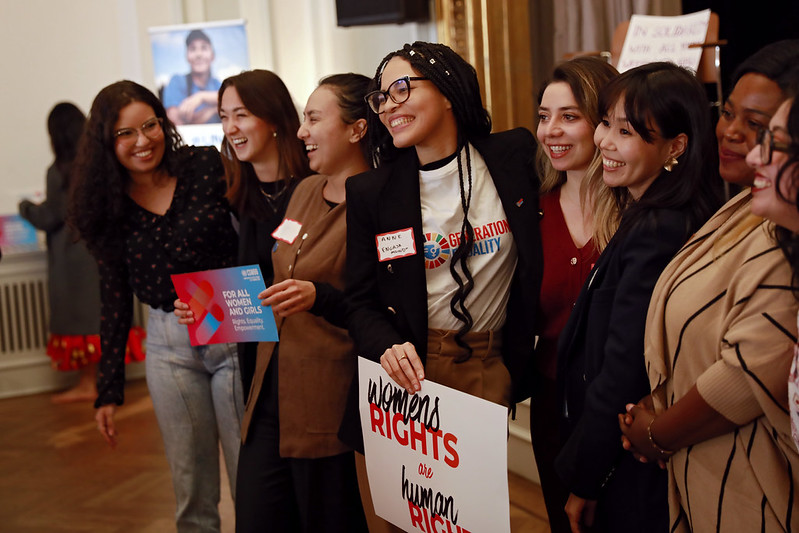
A central finding of the Synthesis Report is that how partners work together directly shapes what they achieve. Generation Equality shows that collaboration itself is a driver of impact.
By fostering trust, inclusiveness and shared ownership, the initiative has enabled partners to:
- Build coalitions across sectors and regions
- Influence policy and global agendas
- Mobilize resources and align efforts
- Respond collectively to emerging challenges and backlash
- Expand leadership spaces for feminist movements and youth



These outcomes are rooted in a way of working that prioritizes participation, co-creation and accountability, demonstrating that effective partnerships go beyond coordination to become engines of change.
What we learned for the future
The experience of Generation Equality offers important lessons for advancing gender equality in a complex global context.
It shows that:
- Inclusive partnerships lead to stronger and more sustainable outcomes
- Shared leadership builds ownership and accountability across actors
- Trust and long-term engagement are essential for collective action
- Breaking down silos enables more coherent and impactful responses
- Equitable resourcing and accessibility remain critical challenges
At a time of growing inequality, shrinking civic space and increasing backlash, these lessons underline the importance of investing in collaborative, flexible and locally grounded approaches. Generation Equality demonstrates that multistakeholder partnerships can serve not only as coordination mechanisms, but as strategic platforms for sustaining progress and driving systemic change.